
Birdsong · October 7, 2026
The Last Twenty Percent
I saw a graphic the other day: AI gets you eighty percent of the way to a working app in a few days, and the last twenty percent takes months. That last twenty percent is where I’ve spent my whole career.
I started in software testing in September 2001. Twenty-five years of finding out what’s wrong with other people’s systems, including multimillion-dollar projects that shaped national infrastructure on two continents. I don’t write TypeScript. I couldn’t build this game by hand.
So here’s how it gets built. I design the game, and I decide what gets built. AI writes the code. Everything in between is process, and process is the part I know.
The board is the truth
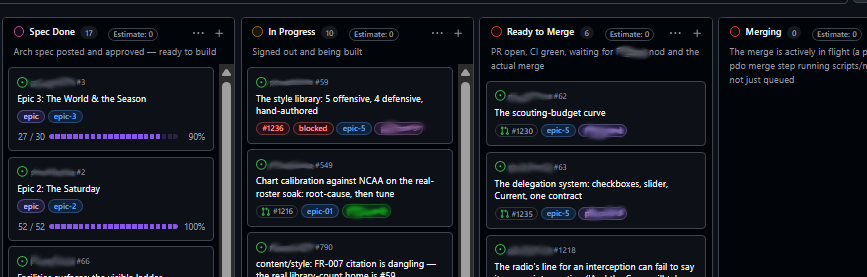
Every piece of work is a ticket on a board, and every ticket moves through the same columns: Backlog, Design, Design Done, Specification, Spec Done, In Progress, Ready to Merge, Closed.
Software developers will recognize this as kanban. It started on Toyota’s factory floor in the late 1940s, where the engineer Taiichi Ohno borrowed an idea from American supermarkets: restock a shelf when it empties, not on a forecast. Software teams picked it up in the 2000s.
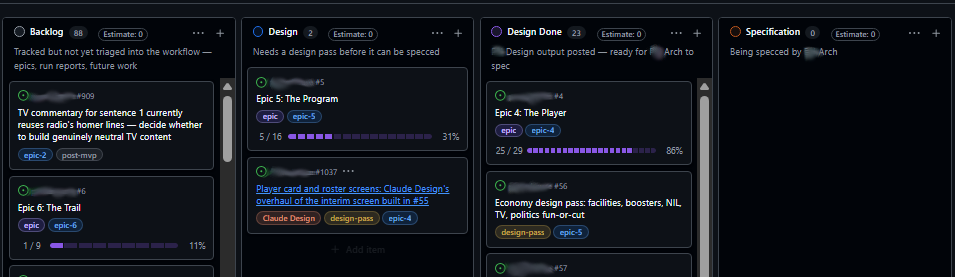
Nothing is done because someone says it’s done. It’s done when the board says so, and the board only says so when the work has been through every column. That sounds bureaucratic, but it means I never have to wonder where anything stands.
A team, with lanes
The work is split between agents, and each one stays in its lane:
- The Design agent walks through each feature with me. I make the calls; it writes down the decisions and why.
- The Architect agent turns those decisions into a spec a developer can build from.
- The Core Developer agents build the tickets, several at once.
- The DevOps agent runs the merge pass, landing finished work only when it passes every check.
- The QA agent tests what got built.
- The Business Advisor agent keeps an eye on the schedule, the market and the launch.
- And the Fun agent, the newest hire, whose whole job is making sure the game is actually fun to play.
The engine is modeled on Paydirt and Bowl Bound, the Avalon Hill and Sports Illustrated games that tabletop fans still love: each coach picks a play in secret, both reveal, and a chart decides what happens. It’s the same idea I played at my dad’s dinner table (Big Red Boxes). The engine itself is original, built from scratch, and every chart comes from our own rosters. When a question comes up about how football works, the answer comes from real football first: how the game is actually played, and what real college football statistics show. Only when that doesn’t settle it is it a judgment call, and those calls are mine, written down in my own words. No agent is allowed to make one.
Testing in layers
This is where a QA background earns its keep. Testing happens at every stage, in layers:
- Every ticket gets its own testing pass before it’s called done.
- Every merge is proven against the current game before it lands.
- Every night, the game plays thirty seasons on its own, start to finish, to catch the things that only show up over time.
- A panel of specialist QA agents combs the whole project in parallel, and every finding gets checked a second time before it counts.
Each layer catches a different kind of mistake. Together they catch almost everything, and the rare miss tells me which layer to strengthen next.
The day I got lost in my own game
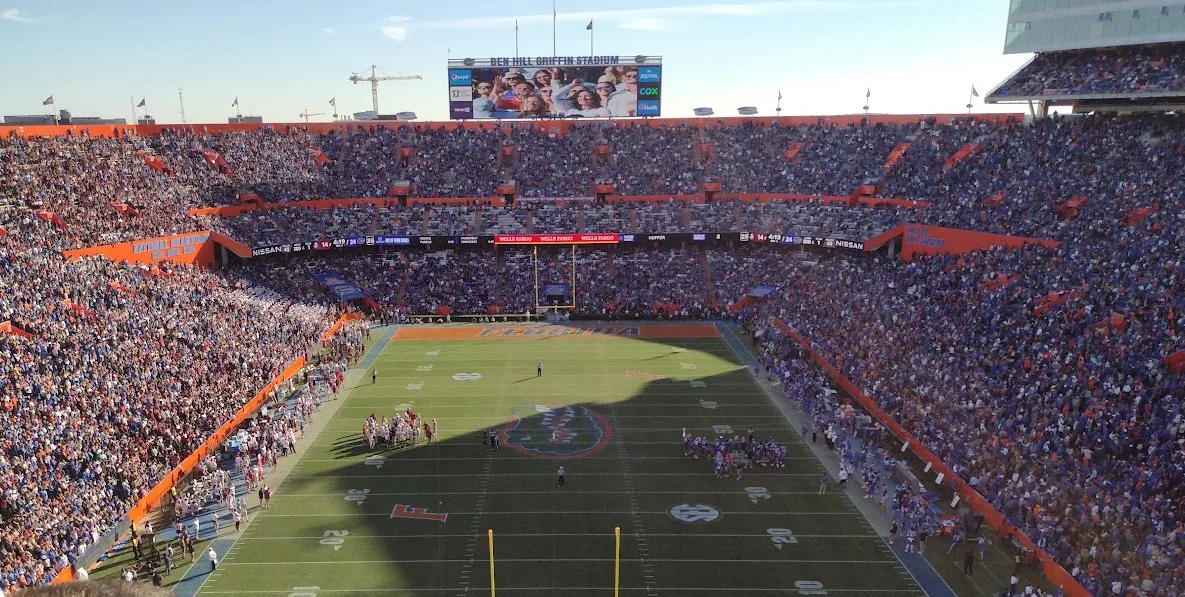
Here’s the story I tell when people ask if AI-built means AI slop. And to be clear, it’s a collaborative effort. I’m overseeing everything but the coding itself.
Early on, while the agents were building the engine that decides how each play turns out, they invented their own vocabulary for it. There was a “gate” that decided whether an advantage mattered. An advantage could “bite,” or half bite, or bite twice. A team had “the edge.” It was all perfectly consistent. I let it go at first, thinking it would be internal and if the agents knew what they were talking about, I could live with it. But soon enough, I got lost in it.
That’s a defect. If the designer can’t follow the words, the player has no chance. So every one of those terms had to go, and every line the game says had to be checked against how real broadcast crews actually call real games.
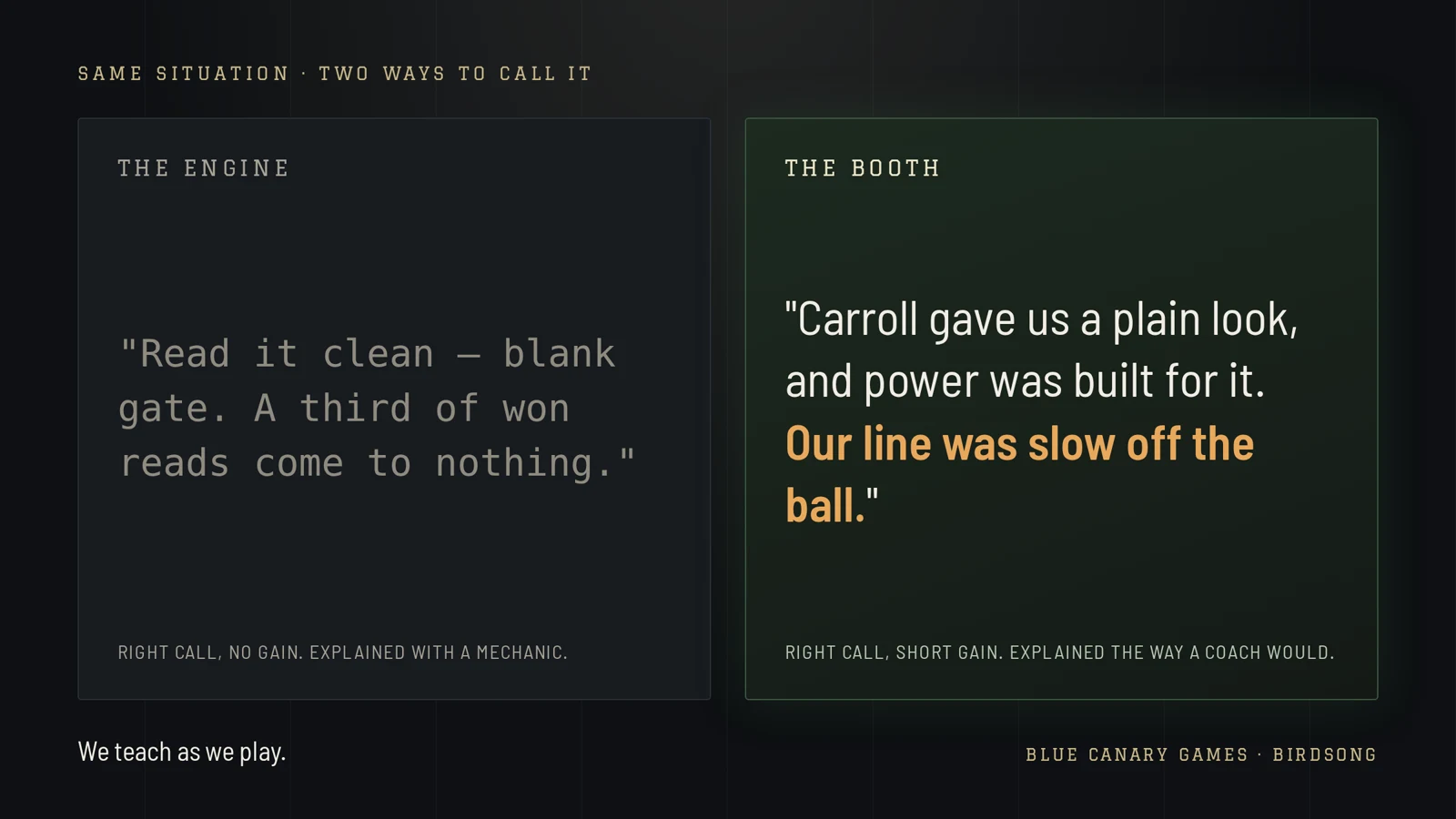
Here’s what the engine used to say:
“Read it clean — blank gate. A third of won reads come to nothing.”
“They called it, triple bite — and still only five. That’s the program.”
Here’s the same kind of play in the game now, called by the home radio crew:
“First and ten, ball at the 43, Valdosta, extra size on the field, handoff to Marcus Teal, downhill, picks up a couple. Rocco Salinger knocks him down. Right around midfield. It’ll be second and nine. Carroll gave us a plain look, and power was built for it. Our line was slow off the ball.”
And the same play from the neutral TV booth:
“Valdosta, loading up with the big bodies, first and ten, at the 43, the handoff to Marcus Teal. Picks up a couple. Carroll has given Valdosta a plain look, and power is built for it. Sloppy blocking.”
The engine knew that the play came up short. The booth tells you why, in words you’d hear on a Saturday afternoon. You called the right play. Your line didn’t hold up its end.
And so, this is how the human player, our coach, learns the game and keeps himself immersed in the moment and the game world. We teach as we play.
Does the process slow it down?
It speeds it up.
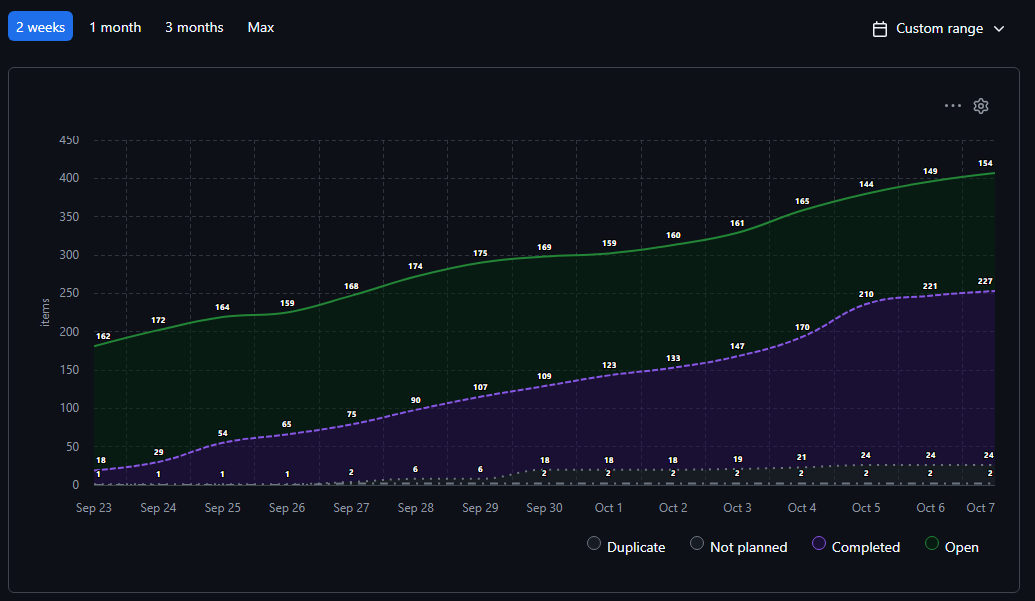
We close more than a hundred tickets a week now, and design and spec run at sixty to seventy tickets a week ahead of the build. After one long week of work on the testing and merge machinery, the full check every change has to pass went from about ninety-seven seconds to about forty. Fast checks mean nobody skips them.
What AI is good at, and what it still needs me for
AI is very good at building. Give it a clear decision and a clear spec, and it will build it, test it and land it faster than any team I’ve worked with.
What it can’t do is know what the game should feel like. It can’t tell when a line of commentary sounds like a machine. It can’t tell when something that works is still wrong. That’s the last twenty percent, and that’s what I hope to finish off in the next few weeks.
Below is a form for your email address. If you’d like to help us beta test before release, sign up and reply to the welcome email. I’d love to hear from you.
The game is the Untitled College Football Game, in development at Blue Canary Games.